

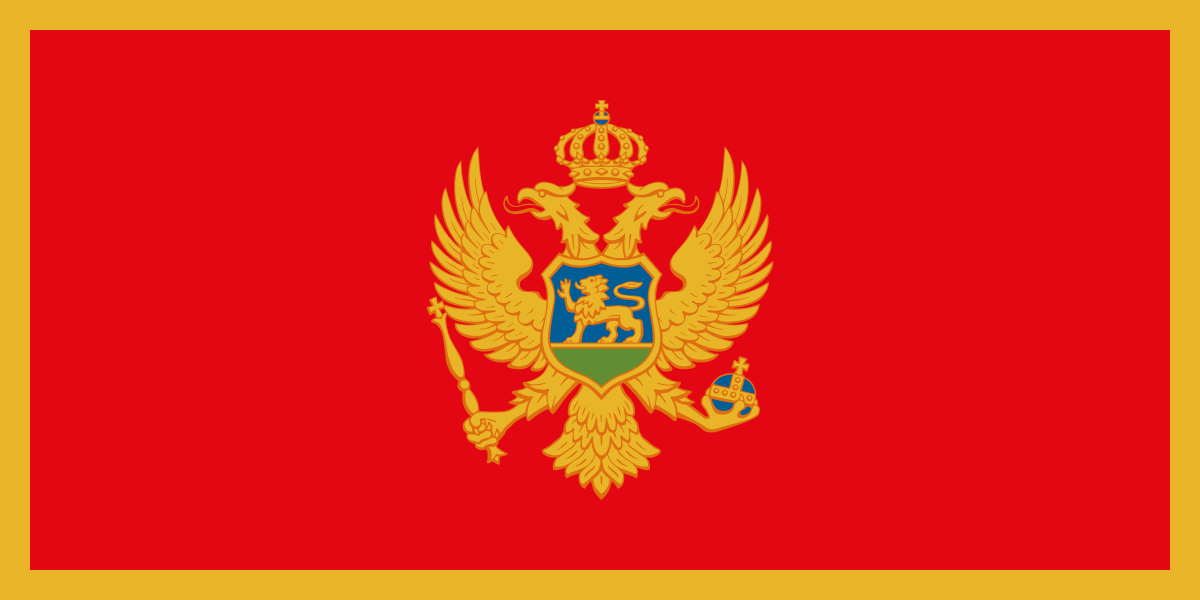
Montenegro
Basic Facts about the Country
Membership of the Council of Europe
11 May 2007
Entry into force of the European Convention on Human Rights
6 June 2006
Basic Facts about the Judiciary
Budget per inhabitant
€ 48.1
(2023 data)
European Commission for the Efficiency of Justice (CEPEJ)
Overall number of judges
Number of professional judges per 100,000 inhabitants
42.6
Tiers in the ordinary court system
3
Basic Courts (First Instance)
20 (general jurisdiction+specialised courts)
Court of Appeals (Second Instance)
2
Supreme Court (Third Instance)
1
Constitutional Court
Yes
- Seven Judges
- Elected by the Parliament of Montenegro with qualified majority
- Two judges are nominated by the President of Montenegro
- Five judges are nominated by the relevant parliamentary body
- The President of the Constitutional Court is elected from among the judges for the period of three years
Main responsibility is to decide on:
- Conformity of laws, regulations and general acts with the constitution and international agreements
- Appeals due to the violation of human rights and liberties after all other efficient legal remedies have been exhausted
- Violation of the Constitution by the President
- Conflicts of competencies
- Prohibition of political parties and NGOs
- Electoral disputes
- Constitutionality of measures and actions taken during a state of emergency or a state of war
- Judges may only be dismissed for reasons defined in the Law on the Constitutional Court
- The Constitutional Court of Montenegro has 7 judges, who are appointed by the Parliament by qualified majority. Two judges are nominated by the President of Montenegro, while five by the relevant parliamentary body. The judges elect among themselves their President for a non-renewable three-year term
- Judges serve non-renewable 12-year terms.
- Judges may only be dismissed for reasons defined in the Law on the Constitutional Court based on the initiative of the President of the Court or at least three judges.
- The Court decides on the conformity of laws, regulations and general acts with the constitution and international agreements; appeals due to the violation of human rights and liberties after all other efficient legal remedies have been exhausted; violation of the Constitution by the President; conflicts of competencies; the prohibition of political parties and NGOs; the constitutionality of measures and actions taken during a state of emergency or a state of war and resolves electoral disputes.
Prosecution Service
The State Prosecution is an independent state authority that prosecutes perpetrators of criminal offences. Its tasks are carried out by the heads of the state prosecution offices and state prosecutors. The Supreme State Prosecutor is elected and dismissed for reasons defined in the Law on the State Prosecutor’s Office by the Parliament upon the proposal of the Prosecutors Council. The Supreme State Prosecutor and the heads of state prosecution offices hold five-year mandates.
Gender breakdown of judges
All instances
Judicial Governance
Type of governance system
Judicial Council
10 members:
One president
Nine members, which include
- The president of the Supreme Court
- Four judges elected and released from duty by the Conference of Judges, taking into account equal representation of courts and judges
- Four lay members from reputable lawyers elected and released from duty by the Parliament at proposal of the competent working body of the Parliament upon announced public invitation
- Minister in charge of judicial affairs
- Consists of the President of the Supreme Court, who presides over the Council, and nine members, including four judges elected by the Conference of Judges to ensure equal representation across different courts, four reputable lawyers elected by the Parliament following a public invitation, and the Minister of Justice.
- The Council members serve a term of four years, which can only be renewed once. They may be dismissed for reasons defined in the Law on Judicial Council and Judges, including if they engage in unconscientious or unprofessional behavior, such as acting contrary to statutory duties, or if they are convicted of a criminal offense that compromises their ability to serve.
Prosecutorial Council
11 members:
- The president (the Supreme State Prosecutor ex officio)
- Five prosecutorial members (prosecutors elected by their peers according to the quotas of representation of different levels and types of prosecution offices)
- Four lay members, including two eminent lawyers, one experienced attorney proposed by the Bar Association, and one distinguished lawyer nominated by NGOs, elected by Parliament by a simple majority of votes
- One member delegated by the Ministry of Justice
- Consists of the Supreme State Prosecutor ex officio, who presides over the Council, and 10 members, including five state prosecutors, two eminent lawyers, one experienced attorney proposed by the Bar Association, one distinguished lawyer nominated by NGOs, and one member delegated by the Ministry of Justice. While the prosecutors are appointed by their peers according to the quotas of representation of different levels and types of prosecution offices, the four lawyers are elected by Parliament by a simple majority.
- The members of the Council serve a non-renewable four-year term.
Court Presidents
Appointed by the Judicial Council through a merit-based public selection process for a five–year term, renewable once.
Distribution of Responsibility

- Appoints and releases from duty the president of the Supreme Court
- Appoints and releases from duty the president of the Judicial Council
- Submits the Report on the performance of the judicial council and the overall judicial situation to the Parliament
- Appoints and releases from duty the judge, the president of the court and the lay judge
- Deliberates on the report on the court activities, applications and complaints regarding the work of the court and takes a standpoint with regard to them
- Establishes the termination of the judicial duty
- Establishes the number of judges and lay judges
- Proposes to the Government the amount of funds required for the work of courts
- Decides on disciplinary liability of judges and court presidents
- Provides for the use, functionality and uniformity of the judicial information system, in the part referring to the courts
- Takes care of the training of judges and court presidents
- Keeps records of data on judges and court presidents
- Considers complaints against the work of judges and court presidents
- Inspects complaints of judges and takes positions regarding threats to their independence and autonomy
- Proposes framework criteria on the necessary number of judges and court administration
- Issues opinions on the incompatibility of performing certain duties with the exercise of judicial office
- Establishes the Commission for Professional Evaluation of Judges
- Appoints the disciplinary plaintiff
- Adopts its Rules of Procedure
The Council makes most of its decisions by majority vote. The Minister of Justice does not vote in disciplinary proceedings.
Responsible for autonomy of the prosecution service:
- Proposing candidates for the position of the Acting Supreme State Prosecutor
- Appointing and dismissing heads of state prosecutor’s offices and state prosecutors
- Making decisions on the termination of functions of these heads
- Suggesting the amount of funds for the State Prosecutor’s Office to the Government
- Furthermore, specific powers of the State Prosecutor’s Office are regulated by the Law on the State Prosecutor’s Office, including decisions on the disciplinary accountability of state prosecutors, taking care of their education, and proposing the dismissal of the Acting Supreme State Prosecutor.
- Manage the court, organisation of court divisions and session of all judges, organisation of trials and internal operation of courts.
- Organise the work in the court, allocate tasks and take measures for orderly and timely performance of tasks in the court.
- Adopt the annual allocation of tasks in the court, ensuring balanced allocation of tasks and the specialization of judges
Challenges

A major problem within the judiciary that Montenegro needs to work on to uphold the rule of law is efficiency. This is currently impaired in the judiciary due to a failure to invest in human resources and infrastructure.
This is reflected in particular by a low clearance rate, especially in administrative and civil proceedings. In 2022, the completion rate was below 90 % and processing times, especially for administrative cases, are very high. The duration of proceedings in administrative cases continued to deteriorate in 2023, which leads to a considerable burden on the system and jeopardizes the rule of law, as citizens and companies must wait a long time for court decisions. At the end of 2023, the number of cases older than 3 years had risen by 20 %. The average processing time rose to 309 days in 2023 compared to 238 days in 2022. It is particularly worrying that the completion time for administrative court cases has risen further to 1,411 days compared to 1,158 in 2022. The completion rate in 2023 remained at 82.49 %.
In May 2024, the Ministry of Justice adopted a new plan for the rationalisation of the judicial network 2024-2027. The plan aims to continue long-term judicial reforms and includes measures to improve the expertise and efficiency of the judiciary. Montenegro must complete the rationalisation of the judicial network based on the existing analyses and the adopted plan.
The excessive length of judicial proceedings remains one of the most persistent challenges facing the judicial system, with the average case now taking between two and three years to resolve. This long-standing problem has been worsening in recent years: in 2023 alone, the number of cases pending for more than three years rose by 20%. The severity of the problem is further illustrated by the fact that this is one of the main recurring issues addressed by the ECtHR in judgments concerning Montenegro.
The growing inefficiency of the judicial system is also highlighted in the European Commission’s 2025 Rule of Law Report, which notes that while some progress has been made in improving judicial efficiency, Montenegro’s courts continue to struggle with substantial case backlogs, particularly in administrative matters. In 2023, the clearance rate across both court instances and all case types remained below 100%, indicating that more cases were filed than resolved, leading to a growing number of pending cases. Administrative cases were especially problematic: after doubling from 2021 to 2022, incoming cases continued to rise in 2023. That year, the first-instance administrative courts had a clearance rate of only 40%, with cases taking an average of 1,422 days to resolve. By 2024, performance improved significantly, with a clearance rate of 109% and a reduced disposition time of 880 days.
However, the same period saw worsening trends in civil and commercial cases, where clearance rates declined and case durations lengthened, while criminal cases showed moderate improvement. The workload in the Administrative Court remains alarmingly high, with each judge handling an average of 2,513 cases in 2024, despite a slight reduction in pending cases—from 27,589 to 26,638. These persistent delays in administrative justice undermine the business climate and weaken public trust in the judiciary. Meanwhile, the Constitutional Court also faces a serious backlog, with 2,069 pending cases as of June 2025, including 1,739 constitutional complaints.
The Judicial Council has adopted a plan to upgrade the court information system (PRIS), which is used for case allocation, tracking, management, and communication with parties. This upgrade, which will be rolled out in the coming period, aims to revise the existing random case allocation procedure, further improving the efficiency of case allocation and the use of judicial statistics.
Additionally, it plans to expand the use of PRIS to misdemeanour courts. But, the digitalisation of the judiciary must be further advanced, especially in terms of communication with the courts.
Montenegro is currently facing a significant shortage of qualified judges and prosecutors as many positions are vacant, which impairs the functioning of the system. 17.6 % of judges’ positions and 39.7 % of public prosecutors’ positions are currently vacant.
In November 2024, Montenegro’s Judicial Council unanimously appointed a new permanent President of the Supreme Court, restoring independence, legitimacy, and stability to one of the judiciary’s key institutions after nearly four years of interim leadership. Despite this important step, institutional gaps remain: the Judicial Council still has one vacant seat, while the Prosecutorial Council lacks two members. More broadly, the timely appointment of judges and prosecutors continues to be a major challenge, largely due to low remuneration levels. By the end of 2024, Montenegro employed only 243 full-time judges out of 329 planned positions—an increase in vacancies compared to the previous year. In contrast, the number of state prosecutors rose from 85 to 114, although this still falls short of the planned 141 posts.
There is also a backlog of constitutional complaints and applications to review the constitutionality of laws. In the past, the Constitutional Court has had problems working fully and efficiently due to an incomplete panel of judges. This has led to delays in important political and legal decisions, such as the confirmation of election results.
Ethical and professional standards are insufficiently promoted or enforced among judges and prosecutors in Montenegro. This is evident in several areas:
The Ethics Commission of the Judicial Council, responsible for determining whether a judge’s conduct is in accordance with the Code of Ethics, is significantly behind in processing cases. Since August 2022, the Commission has not issued any decisions in the 19 pending cases, indicating a lack of oversight. In addition, there is no legal recourse for judges to challenge the Ethics Commission’s decisions, although this is provided for by law. The Ethics Commission of the Council of Public Prosecutors has also only dealt with a few cases.
In addition, existing accountability obligations are not enforced. Judges and prosecutors in Montenegro are obliged to declare their assets and income and to report on possible conflicts of interest each year, with the Agency for the Prevention of Corruption responsible for verifying these declarations. However, compliance remains weak: the disciplinary measures for failing to submit these declarations are considered misdemeanour proceedings, and there have been no criminal convictions based on the verification procedures. The problem is also exacerbated by the weaknesses in the control system, as the verification could be improved through more intensive checks and effective disciplinary measures.
Beyond the issue of insufficient enforcement, existing guidelines have also been criticized as inadequate. There has been only modest progress in implementing codes of professional ethics for notaries, bailiffs, and court interpreters, with the code for lawyers yet to be adopted by the Bar Association.
The issue of political interference in the work of the judiciary in Montenegro has been the subject of discussion and concern for several years and presents a challenge to the rule of law.
Significant delays in the appointment of high-level personnel have ultimately had an impact on the judicial system.,. After a long period of political standstill, in November, December 2023 and January 2024, Parliament at least appointed a new permanent Supreme Public Prosecutor, three lay members of the Judicial Council and a judge of the Constitutional Court by a qualified majority as part of a transparent and merit-based selection process.
Despite some efforts to reform the system and strengthen the autonomy of prosecutors, there are still allegations of political influence on the work of prosecutors: One of the main problems in this context is the composition of the Prosecutorial Council and the influence of political parties on the selection and appointment of members of the Prosecutorial Council. In April 20204 for example, the arrest of a former special prosecutor sparked a fierce controversy, highlighting the deep political divisions and pointing to a possible abuse of the judicial system to settle political disputes. The prosecutor was accused of formation of a criminal organisation and abuse of office, critics said these allegations were politically motivated and an act of revenge.
In addition, stakeholders reported cases of undue influence and public attacks on the Bar through derogatory public statements by government representatives, which are directed against individual lawyers and the Bar and can contribute to undermining public confidence in the judiciary.
The politicization of judicial appointments at the Constitutional Court has been an ongoing issue that has gravely impacted the court’s capacity to function and deliver its mandate.
The Parliament’s persistent inability to elect new judges caused the shutdown of the Court’s operations between September 2022 and February 2023, effectively leaving it without the necessary quorum to deliver judgments with only three out of the seven judges appointed. In February 2023, under pressure from the European Commission, which threatened to suspend accession negotiations, three new judges were elected. Finally, in November 2023, more than three years after the start of the appointment process, the last judge was elected. However, the Constitutional Court’s inability to function resulted in a large case backlog.
At the end of 2024, a deep institutional and political crisis emerged over the Parliament’s decision to unilaterally declare the retirement of a Constitutional Court judge, in disregard of the procedure outlined in the Constitution, requiring a plenary decision of the Court itself. The move raised concerns about the respect for the independence of the Constitutional Court and plunged the legislative branch into deadlock for months. The government and opposition reached a political agreement in March, which included requesting the Venice Commission’s opinion on the Parliament’s decision, which was published in June. Despite these developments, the Parliament’s procedure for selecting a replacement for the concerned Constitutional Court judge continued.
Despite some efforts to reform the system and strengthen the autonomy of prosecutors, there are still allegations of political influence on their work. One of the main problems in this context is the composition of the Prosecutorial Council and the influence of political parties on the selection and appointment of members of the Prosecutorial Council. In April 2024, the former Special Prosecutor sparked a fierce controversy, highlighting the deep political divisions and pointing to a possible abuse of the judicial system to settle political disputes. The Prosecutor was accused of forming part of a criminal organisation and of abuse of office; however, critics found these allegation
Positive Developments & Achievements
New strategy for Judicial Reform 2024-2027
With regard to the judicial system, essential foundations for improvement have been laid. In May 2024, Montenegro adopted a new Strategy for Judicial Reform 2024-2027. With this new strategic framework, substantial amendments to the Law on the Judicial Council and Judges, the Law on the Public Prosecutor’s Office, and the Law on the Special Prosecutor’s Office were adopted to align them with the EU acquis and European standards based on the recommendations of the European Commission and the Venice Commission.
The strategy aims in particular at strengthening the quality, efficiency, and independence of the judicial system, improving access to justice, and increasing confidence in the judicial system. The government has set up a new Council to monitor the implementation of the strategy, which includes representatives of the key players from the executive, judiciary, and public prosecutor’s office. The action plan for the period 2024-2025 provides for amendments to the Act on the Judicial Council and Judges, the Act on the Public Prosecutor’s Office, the Act on the Special Public Prosecutor’s Office, the Act on Amendments to the Courts Act and the Code of Criminal Procedure, which were adopted in June 2024. Preparations are also underway within the government to amend the Criminal Code.
Anti-corruption strategy 2024-2028
Montenegro has identified and implemented measures to reduce corruption in vulnerable areas. A new National Anti-Corruption Council, chaired by the Deputy Prime Minister, was established in February 2024 to draft the new strategy, adopted on 4 June 2024, as well as the 2024-2025 action plan. The adoption of the anti-corruption strategy for the period 2024-2028 represents a significant step towards alignment with European and international standards. In the new strategy, the following areas are classified as at particular risk of corruption: Justice, police and customs administration, environment, urban planning, public procurement, local self-government, and state-owned enterprises. The strategy contains specific measures to combat the risks in these areas. In addition, the Court of Audit is currently implementing a methodology to assess the application of anti-corruption measures in the judiciary and state authorities in the area of social and child welfare. Reports on the use of this methodology have been published or are in preparation. In 2023, the government amended its rules of procedure to require the implementation of potential corruption risk assessments for legislative initiatives.
In addition, a new law on the prevention of corruption and amendments to the law on the confiscation of assets were enacted, representing a significant improvement in the legal framework and eliminating existing loopholes.
Rankings and Surveys
Expert Recommendations

The Commission’s recommendations from last year were partially implemented and remain
largely valid. In the coming year, Montenegro should, in particular:
- proceed with appointments to high-level judicial positions through merit-based and
transparent procedures, including to the Constitutional Court and the Judicial and
Prosecutorial Councils, to ensure the independence, accountability and proper
functioning of the justice system; - continue strengthening judicial independence and ensuring full and effective
implementation of the improved strategic and legal framework and further align the legal
framework, including the Constitution, in particular on the composition and decision
making process of the Judicial Council and Prosecutorial Council, with the EU acquis and
European standards on judicial independence and accountability, irremovability,
impartiality, integrity, efficiency and professionalism of the judicial system, addressing
the recommendations from the European Commission, the Venice Commission and the
Council of Europe Group of States against Corruption (GRECO). - improve the justice system’s overall efficiency, including a reduction of the backlog of cases across the judiciary and by implementing targeted measures, particularly in the
High Court of Podgorica, the Administrative Court of Montenegro and the Special State
Prosecution Office and by ensure full implementation of the Plan for rationalisation of the court network and the 2025-2028 Judicial Digitalisation Strategy.
 2025 Enlargement Package - Montenegro Report
Adopted by GRECO at its 84th Plenary Meeting (Strasbourg, 2-6 December 2019)
GRECO concludes that Montenegro has implemented satisfactorily eight out of the eleven recommendations contained in the Fourth Round Evaluation Report.
Recommendation v. remains not implemented GRECO recommended
- taking additional measures to strengthen the Judicial Council’s independence – both real and perceived – against undue political influence, including by abolishing the ex-officio participation of the Minister of Justice in the Council, by providing for no less than half of the Council’s membership to be composed of judges who are elected by their peers and by ensuring that the presiding function is given to one of those judicial members;
- establishing objective and measurable selection criteria for non-judicial members which would endorse their professional qualities and impartiality; and
- setting in place operational arrangements to avoid an over-concentration of powers in the same hands concerning the different functions to be performed by members of the Judicial Council.
Recommendation vii. remains not implemented. GRECO recommended
- further developing the disciplinary framework for judges with a view to strengthening its objectivity, proportionality and effectiveness; and
- publishing information on complaints received, disciplinary action taken and sanctions applied against judges, including possible dissemination of the relevant case-law, while respecting the anonymity of the persons concerned.
To achieve a better judicial system, Montenegro should
- appoint a permanent President of the Supreme Court, as well as other high-level judicial positions, through a merit-based and transparent procedure, to ensure the proper functioning and accountability of the justice system;
- ensure full and effective implementation of the improved strategic and legal framework to address existing challenges, and further align the legal framework, including the Constitution, in particular on the composition and decision making process of the Judicial Council, with the EU acquis and European standards on judicial independence, accountability, impartiality, integrity, efficiency, and professionalism of the judicial system, addressing the remaining recommendations from the European Commission, the Venice Commission and the Council of Europe Group of States against Corruption (GRECO), to decisively restore the stability, credibility and public trust in the justice system;
- fully implement the Plan for the rationalisation of court network and the Strategy for digitalisation of the judiciary, to improve human, financial, and physical infrastructure in the judiciary and state prosecution service.
To fight corruption, Montenegro needs to
- ensure full and effective implementation of the improved strategic and legal frameworks to address existing challenges, and continue its alignment with the EU acquis and European standards on prevention and fight against corruption by addressing the remaining recommendations from the European Commission, the Venice Commission and the Council of Europe Group of States against Corruption (GRECO) and peer review missions, including on its institutional set up and effective functioning;
- further improve the track record on corruption, including high-level corruption, by urgently strengthening the effective enforcement of the existing criminal legislation by the prosecution and courts, including by imposing effective and deterrent penalties;
- urgently amend Law on financing of political entities and election campaign to address the existing shortcomings and bring it fully in line with European standards, to substantially increase transparency and control of the spending of political parties, and prevent the abuse of state resources, including through dissuasive sanctions.
In the above referred Opinion the Venice Commission examines the procedure in Montenegro for early termination of the mandates of Constitutional Court of Montenegro judges on the basis of age limits, and it offers a set of recommendations aimed at strengthening judicial independence, constitutional safeguards, and legal certainty. The key recommendations are as follows:The Commission first stressed that the legislation governing the Constitutional Court should explicitly regulate the retirement age of its judges, as the lack of clear and coherent rules had led to the previous dispute. Secondly, it proposed introducing a simple default mechanism for notifying when judges reach retirement age, to prevent institutional deadlock or abuse. For instance, the law could empower the President of the Constitutional Court to notify relevant authorities of an upcoming vacancy without requiring a formal vote.
Thirdly, the Commission reiterated its earlier recommendation to allow judges whose mandates have expired to remain in office until their successors are appointed, thus ensuring continuity and avoiding vacancies. Finally, it advised expanding the rules on the recusal of judges in cases of conflict of interest, while safeguarding procedural guarantees and the Court’s ability to function effectively.
Compliance with European Courts' Judgements
European Court of Human Rights (ECtHR)
State Performance
 Good
Good
Implementation record


6

25 %

39
Judgements with pending implementation
SINIŠTAJ AND OTHERS v. MONTENEGRO
This case concerns ill-treatment in police detention and the lack of an effective investigation into it.
The applicants were arrested by a special anti-terrorist unit. According to them, they were mistreated by the police during the arrest, detention, and before the investigating judge. These mistreatments allegedly included beatings, deprivations of food, verbal abuses, and threats. The investigating judge included the applicants’ statements about the alleged mistreatment as well as notes about visible injuries in the interrogation record. A few days later, the applicants lodged criminal complaints against unidentified police officers. The authorities failed to process all complaints.
As a result of the judgment, the Montenegrin authorities established regular training and awareness-raising activities for police officers, adopted a “zero-tolerance” policy of ill-treatment by police and law enforcement, abolished the statute of limitations for the crime of torture, and introduced more serious sanctions for ill-treatment by state agents. The impact of these measures is currently under assessment.
1451/10, 7260/10 and 7382/10
02-05-2016
Siništaj v. MONTENEGRO
This case is about the excessive length of proceedings before the Constitutional Court of Montenegro.
The applicant, who was found guilty of associating with others for the purposes of anti-constitutional activities and preparing actions against the constitutional order and security of Montenegro, lodged a constitutional appeal against the proceedings in his case. This appeal was based on alleged violations of the presumption of innocence, the right to a defence, and the inviolability of the home, as well as on having been convicted on the basis of unlawfully obtained evidence. The applicant lodged the appeal in March 2010 and urged the Constitutional Court to rule on the matter in April 2011. In April 2013, the Court did not adopt a draft judgment prepared by a judge rapporteur. When the judge died in August 2013, the case was reassigned. Parliament elected seven new judges to the Constitutional Court in December 2013. In July 2014, the Constitutional Court dismissed the applicant’s constitutional appeal. Before the ECtHR, the applicant argued that the length of proceedings had been excessive, thus violating Art. 6(1) ECHR (right to a fair trial). The Court unanimously agreed with him and confirmed that Art. 6(1) was violated.
Regarding the judgment’s implementation, the Parliament of Montenegro filled the remaining vacancy at the Constitutional Court, making it fully operational again. The authorities took some further measures, such as providing statistics on the functioning of the court, electing two new legal advisers, and submitting amendments to the Law on Civil Servants and Employees, aiming at enabling the Court to gain independence and autonomy. The judgment’s full implementation is under supervision, additional statistics on the court’s backlog, processing of cases, resolution of staffing problems, and pending law amendments were requested.
31529/15
23-09-2021
BIGOVIĆ v. MONTENEGRO
In this case, the ECtHR found a violation of Art. 5(1) and (3) (right to liberty and security) and violation of Art. 3 (prohibition of torture) ECHR concerning the conditions of detention of the applicant, who was serving a 30-year prison sentence in Spuž (Montenegro). The ECtHR found a violation of Art. 3 regarding the conditions of detention due to extreme overcrowding in the pre-trial detention centre and the condition of the cells. The Court found that there had been a violation of Art. 5(1) with regard to the lack of precision in detention orders in respect of the duration of extensions and periods where more than two months passed after the indictment was issued without new orders extending the applicant’s detention. The Court also found a violation of Article 5(3) as the courts had failed to take into account the personal circumstances to be considered in relation to the risk of absconding when prolonging the detention, and the domestic courts had failed to make explicit findings on the proportionality of the applicant’s continued detention.
After the ECtHR judgment, the Supreme Court of Montenegro took measures to ensure that courts provide sufficient reasoning for detention extensions. The applicant’s case has been reopened, and he is currently in detention on remand. According to the authorities, his detention is regularly re-examined. The judgment’s implementation is under supervision by the Committee of Ministers.
48343/16
19-06-2019
Further Readings
Acknowledgements
Konrad Adenauer Stiftung Rule of Law Programme South East Europe
The data and analysis for this country were contributed by the experts of the Rule of Law Programme South East Europe of the Konrad Adenauer Stiftung